Commercial swine herds face pressure every day. The question is, how should genetics advance to support consistent, predictable performance? For PIC, the answer is robustness – where resilience and resistance intersect.
What kind of pig is best equipped for commercial production? Typically, answers circle back to a pig that can manage disease pressure and production system variations while creating the most margin opportunity.
How we get there through genetic progress has been more debated.
Should genetic improvement focus on pigs that can maintain performance through the challenges they encounter, or on creating pigs less susceptible to disease in the first place? Ultimately, are we focusing on resilience or resistance?
“Every genetic supplier will eventually have to answer both questions,” says Matt Culbertson, PIC Chief Operating Officer. “The differentiator is whether you’re advancing them together or trading one for the other.”
PIC believes the answer is both. Robustness is created where resilience and resistance intersect.
Why Resilience and Resistance Are Essential
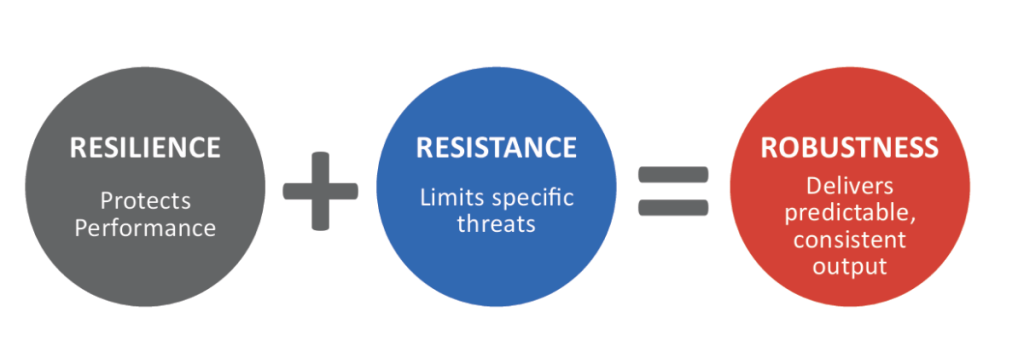
Resilience and resistance accomplish different things and understanding that distinction is central to developing a more robust pig. Resilience protects performance. It’s the ability of a pig to maintain or quickly regain performance following a disease, environment or management challenge. For example, a pig may maintain growth more effectively or return to its expected performance more quickly.
Resilience has broad value in commercial production because pigs rarely experience perfectly controlled conditions. Health challenges, environmental changes, feed transitions and management differences are all production realities. Genetics that help pigs perform more consistently through those pressures can contribute to more predictable outcomes.
Resistance limits the impact of a specific pathogen.It can reduce susceptibility, infection, pathogen load or transmission associated with a targeted disease threat. A resistant pig, for example, may be less susceptible to a particular disease or may carry and shed less virus.
Resistance therefore offers a more targeted tool. Rather than helping the animal perform through broad challenges, resistance addresses a specific disease threat and may contribute to both individual animal health and herd-level disease control.
PIC formulizes the relationship as:
Resilience + Resistance = Robustness
The two approaches are complementary rather than competing. Resilience provides broad protection of performance across many pressures while resistance offers a layer of specific protection against high-impact disease threats.
The Value of Robustness
To see the real value of robustness, look beyond an individual pig. Variation has consequences throughout an entire production system.
When pigs respond to pressures inconsistently, the differences impact growth, feed efficiency, mortality, barn flows and even marketing – ultimately affecting cost per pig, output and profitability.
A robust pig is designed to make outcomes more predictable. It doesn’t mean genetics will eliminate disease or remove the need for strong health, nutrition and management. Instead, genetics become another tool for building greater consistency into the production system.
Consider two groups of pigs exposed to similar commercial pressures. If one group experiences greater variation in performance, producers may have more pigs falling behind expected growth or leaving the system before reaching full value.
A group that performs more consistently can see more pigs staying on track and more full-value pigs reaching market. Greater consistency can also make it easier to anticipate barn flow, feed needs and marketing commitments.
North America industry data suggests what that consistency is worth. From May 2025 through April 2026, average reported net profit was $39 per hog, compared with $53 per hog for the top 25% of operations, a $14 difference on the same commodity in the same market.[1]
“Robustness is not just an animal-health concept,” says Culbertson. “It’s also a production and economic concept with the potential to help producers everywhere capture more of that value.”
How Robustness is Built
Robustness is not a single gene or trait simply added to a breeding objective.
Instead, it is the result of selecting for multiple characteristics that contribute to performance under commercial conditions. PIC’s approach is to advance resilience and resistance simultaneously while continuing to select across the broader set of traits that contribute to whole-pig value.
For resilience, that means understanding which genetic families perform consistently under real-world production conditions.
Commercial data plays an important role. Performance differences that stay hidden in ideal or low-pressure environments become substantially visible when pigs encounter the normal variation present on commercial farms.
For more than 20 years, PIC has used commercial performance data to identify those differences and incorporate them into genetic selection. The objective is to select genetics capable of delivering exceptional, predictable performance across real-world conditions, not just in ideal ones.
Resistance development builds out the other half of the equation.
Technological advancements like gene editing are creating opportunities to target specific, high-impact diseases. One example is porcine reproductive and respiratory syndrome (PRRS), where PIC has developed a gene-edited pig with resistance to the disease.
Another example is E. coli resistance development. PIC was the first to identify and use the F18 (FUT1) marker to select for pigs genetically resistant to E. coli infection, known to cause diarrhea, edema and death in young pigs. PIC has continued selection for the favorable allele associated with F18 resistance and has more recently expanded that work to include F4, resulting in increasing resistance across commercially available lines.
Targeted resistance doesn’t replace resilience – the two work together to create a more predictable pig.
Even as the industry develops tools against targeted diseases, pigs will continue to encounter other health challenges as well as environmental, nutritional and management pressures. Broad resilience therefore remains important.
Likewise, resilience does not eliminate the value of preventing a disease threat from affecting the pig in the first place.
Robustness brings both strategies together.
From Robustness to More Predictable Production
The goal is to connect genetic progress with outcomes that matter at the farm level.
That includes pigs maintaining performance through everyday production pressures, fewer pigs falling out and more pigs reaching market at full value.
Over time, even relatively small improvements in consistency or survivability become meaningful when multiplied across groups, barns and entire production systems.
“By combining resilience and resistance, we’re building robust pigs that deliver more consistent performance and capture more value across the production system,” says Culbertson.
The industry’s genetic toolkit is expanding, and producers don’t have to choose between a more resilient or resistant pig. They can have both.
Resilience protects performance. Resistance limits specific threats. Together, they build robustness.
It is a simple formula for a much broader objective: creating pigs designed to deliver value through the realities of commercial production.
Learn more about the science, selection strategies and commercial data behind PIC’s approach in the full Robust by Design technical bulletin.
[1] Based on Agri-stats May 2025-April 2026 reported operation farm profits per hog.