PIC’s Pork Chop Studio improves accuracy of pork quality data and could someday predict consumer preference – before a bite is taken.
Today’s consumers expect high-quality, flavorful protein options in an increasingly competitive marketplace. For the pork industry, delivering a consistently great eating experience has become a priority across the entire value chain.
“Meat quality, as a key driver of demand, continues to come up in industry conversations,” says Justin Holl, PIC Product Development Senior Director. “The timing couldn’t be better to develop tools to help us optimize pork on the dinner plate.”
Improving pork quality, however, doesn’t happen overnight. It starts with having accurate, reliable data – something the new PIC Pork Chop Studio was designed to deliver.
Improving Accuracy in Meat Quality Measurements
“For a long time, PIC has analyzed loin samples for quality attributes,” says Eric Psota, PIC Digital Innovation Senior Manager. “Expert-trained evaluators manually look at each loin to assign a marbling score. It not only requires a specialized skillset, but also introduces subjectivity, which can cause variability in results.”
In addition to marbling, employees manually measure pH, color and tenderness using specialized tools including a pH meter, Minolta colorimeter and Warner-Bratzler shear force. These tools allow for objective measurement but are still time consuming.
“PIC’s Applied Meat Science Team saw an opportunity to remove subjectivity, reduce variability and improve efficiency across the meat quality evaluation process,” says Psota. “With the new PIC Pork Chop Studio, we’ve done just that.”
Removing Human Variability with Pork Chop Studio
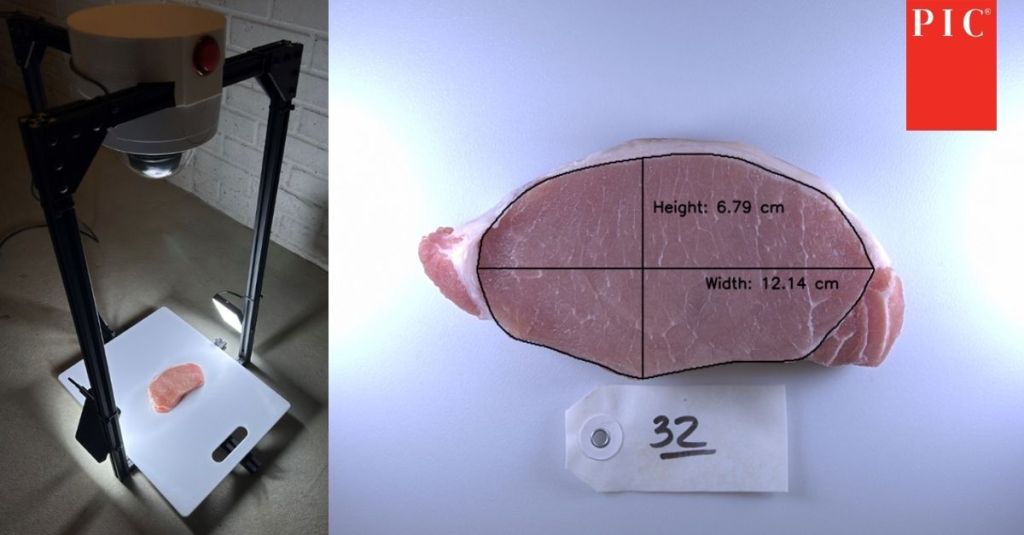
Recently, PIC’s Digital Phenotyping Team developed a custom imaging station – now known as Pork Chop Studio – using computer vision and deep learning to automatically evaluate pork quality traits.
“At its core, Pork Chop Studio is a high-end camera system with studio lighting that captures 4K images at the touch of a button,” says Psota. “These images reveal extremely fine details, like muscle fiber striations and other characteristics not easily visible to the human eye.”
Once captured, images are sent to a server where an AI model predicts a marbling score. To train the system, three PIC experts manually scored nearly 1,300 loin images. A consensus average of those scores was then used to train the AI neural network.
Like the human brain, neural networks learn by identifying patterns and improve over time with more data. Unlike the human brain, they deliver results without emotion or distraction.
“The neural network provides an expert-level score every time,” says Psota. “If you gave the same loin image to a human scorer 10 minutes apart, you could easily get different results depending on mood, focus or fatigue.”
Going Beyond Marbling Scores
Eliminating manual marbling scoring was the initial goal – and Pork Chop Studio can deliver on that goal today. Now, the technology is being trained to streamline other aspects of meat quality evaluation.
“With the level of detail in these images, we can also measure loin height, width and circumference – things that are incredibly difficult to measure manually,” says Psota.
PIC has also captured more than 5,000 images of loins with pH measurements and is training the neural network to predict pH from images alone.
“Previously, a pH meter was our only option,” Psota explains. “Now, we’re seeing the system pick up on visual cues – perhaps surface moisture or reflectance – that correlate to pH.”
The same is true for loin color.
“We’re eliminating the need for specialized labor and tools like pH meters or colorimeters,” says Psota. “All employees need to do is place a pork chop on the studio platform, press a button, remove the chop and move on to the next one.”
Realized labor savings have been redirected to higher-value tasks, such as capturing repeat images after 12 days of aging to further improve data accuracy and exploring new quality attributes altogether.
Driving Genetic Progress for a Better Eating Experience
Accurate data is only the first step. The real value comes from using that data to drive genetic progress in meat quality.
“With Pork Chop Studio, we’ve increased data accuracy, improved consistency across plant locations and maintained the real-time speed needed to feed data right back into our selection index,” says Holl. “That enables faster, more reliable genetic progress.”
“Our commitment to meat quality really allows us to shape genetics in a way that benefits everyone – from producer to packer to consumer,” adds Brandon Fields, PIC Applied Meat Sciences Global Director. “If technology ultimately helps us select for better meat quality and encourages more pork consumption globally, that’s a win across the entire value chain.”
Could Consumer Preference Be Predicted?
Could Pork Chop Studio someday predict consumer preference? Absolutely.
“We intend to conduct trained taste panel evaluations where we have images of pork before it’s cooked along with human taste responses,” says Fields. “With the data, we plan to train the system to identify the most flavorful piece of pork before it’s ever cooked and given to the tasting panel. That’s our ultimate pursuit.”
“We’re not just focused on consumer acceptance,” Fields adds. “We’re focused on optimizing pork quality to increase demand and deliver the ideal eating experience.”
Read the full Pork Chop Studio abstract or contact PIC at AppliedMeats@genusplc.com.
Bery, S., Psota, E., Holl, J., Fields, B., Matthews, N., Eastwood, L. C., & Fitzgerald, R. (2025). Automated evaluation of pork chop quality traits via computer vision and deep learning. Abstract presented at the International Congress of Meat Science and Technology (ICoMST 2025).